Team eatamame

There's no single number for everyone: to know how many calories to eat to lose weight, estimate your own needs (resting metabolism × activity level) and subtract about 500 kcal a day. Then track your weight for a few weeks and adjust: a pace of 1–2 lb (0.5–1 kg) a week is realistic and sustainable.
Why there's no one-size-fits-all number
How many calories you should eat to lose weight depends on how many you burn. A common rule of thumb is about 2,000 kcal a day for an average woman and 2,500 for an average man, but the real figure changes with your age, weight, height and how much you move1.
That's why the fixed numbers you see online (1,200, 1,500, 1,800) work for some people and not for others. A more useful approach: estimate your own needs, subtract a moderate amount, then watch how your body responds.
How to work out your calories in 4 steps
1Estimate your resting metabolism
Your resting metabolism is the energy your body uses just to keep running, before any movement. One of the most widely used formulas is Mifflin-St Jeor2:
- men: 10 × weight (kg) + 6.25 × height (cm) − 5 × age + 5
- women: 10 × weight (kg) + 6.25 × height (cm) − 5 × age − 161
Using pounds and inches? Multiply pounds by 0.454 to get kilograms and inches by 2.54 to get centimeters. It's an estimate: two people with the same stats can burn slightly different amounts. That's fine, because step 4 is there to correct it.
2Multiply by your activity level
Next, add the movement in your day by multiplying by a physical activity level (PAL). Typical values range from 1.4 for sedentary people to 2.5 for very active people; 1.6 describes someone who mostly sits at work and does moderate exercise at least once a week3.
| Activity level (approximate) | Example | Multiplier |
|---|---|---|
| Sedentary | Desk job, little movement | 1.4 |
| Lightly active | Desk job, a walk or workout once a week | 1.6 |
| Active | On your feet at work or moving most days | 1.8 |
| Very active | Physical job or intense exercise every day | 2.0–2.5 |
The result is your maintenance calories: the amount at which your weight stays roughly stable.
Try this: if you're between two levels, start with the lower one. Step 4 will tell you if you need to move it up.
3Subtract a moderate deficit
To lose weight, you need to eat a bit less than you burn. Weight-management programs usually aim for a deficit of 500–750 kcal a day4. A pace of 1–2 lb (0.5–1 kg) a week is the recommended rate for steady weight loss5.
In professionally supervised programs for people with overweight, the target often ends up around 1,200–1,500 kcal for women and 1,500–1,800 for men, always adjusted for each person's weight and activity4. These are reference values, not a floor to aim for: diets under 800 kcal should only be followed under medical supervision5.
4Track your weight and adjust
The number you worked out is a starting point. Weigh yourself at the same time of day a few times a week and look at the trend over 2–4 weeks, not a single day:
- losing about 1–2 lb (0.5–1 kg) a week: keep going;
- weight hasn't moved for 3–4 weeks: trim your portions a little or add some movement;
- losing more than 2 lb (1 kg) a week for many weeks: you're probably eating too little, so add something back.
Two worked examples
Here's how it works with real numbers. Results are rounded.
| Person A | Person B | |
|---|---|---|
| Stats | Woman, 35, 5'5" (165 cm), 154 lb (70 kg) | Man, 40, 5'11" (180 cm), 187 lb (85 kg) |
| Resting metabolism | about 1,400 kcal | about 1,780 kcal |
| Activity level | 1.6 (desk job, walks) | 1.6 (desk job, weekly soccer) |
| Maintenance calories | about 2,230 kcal | about 2,850 kcal |
| With a 500 kcal deficit | about 1,730 kcal | about 2,350 kcal |
As you can see, the result is nowhere near the classic 1,200 kcal: for many people, eating that little would mean too big a cut to keep up.
Why weight loss slows down after a few weeks
A popular rule says a 3,500-calorie deficit equals one pound of weight lost. It's a static calculation: it ignores the fact that your body adapts. As your weight drops, so do your resting metabolism and the energy you spend moving6.
In practice, your starting deficit shrinks on its own over the weeks, and weight loss slows down. It doesn't mean you did anything wrong:
- recalculate your needs every time you've lost a few pounds, using your new weight;
- keep moving, or move a bit more, to help make up the difference;
- don't chase bigger and bigger cuts: a small adjustment works better.
It's not just how many calories, but which ones
Calorie for calorie, some meals keep you full much longer than others. To make a deficit work without feeling hungry all the time:
- protein at every meal: it keeps you full longer and helps you hold on to muscle while you lose weight7. Beans, lentils, yogurt, eggs, tofu and dairy are easy options;
- vegetables and whole grains: they fill your plate with fewer calories;
- watch liquid calories: soda, juice and alcohol add up fast and don't fill you up.
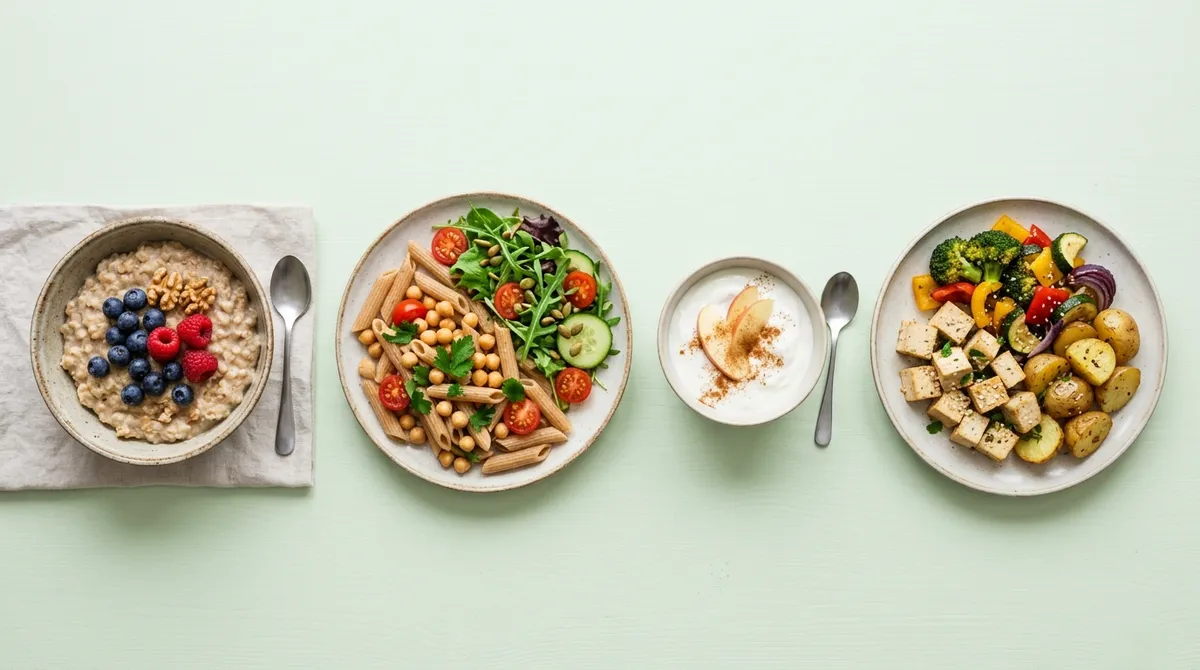
Here's what a day with a moderate deficit might look like: oatmeal and fruit for breakfast, whole wheat pasta with chickpeas for lunch, yogurt and fruit as a snack, tofu with vegetables and potatoes for dinner. It's not a menu to copy: portion sizes depend on your own needs. For more practical ideas, read our guide on how to lose weight without dieting.
How to know how many calories you actually eat
Working out your needs is half the job: the other half is knowing how much you eat today. Research consistently links tracking your meals with weight loss8. You don't need to weigh everything: even an estimate, done consistently, shows you where the calories go.
With eatamame you set your goal and get a personalized plan with an estimated date for reaching it. Then just snap a photo or describe your meal, even by voice, to see estimated calories and macros. If you want tips on photographing your plates, check out the guide on how to count calories from a photo.
The most common mistakes
- Copying someone else's number: a friend's or coworker's needs can be very different from yours.
- Cutting too much: a bigger deficit is harder to stick with, and very low-calorie diets (under 800 kcal) are only for medical supervision5.
- Counting exercise twice: if it's already in your activity level, don't add it on top of your daily calories.
- Forgetting dressings, drinks and bites: these are the calories that slip through most often.
- Judging after a few days: your weight goes up and down with water and salt. What counts is the trend over a few weeks.
Frequently asked questions
Is 1,200 calories a day enough to lose weight?
+
For many people it's too little: 1,200 kcal is a figure used in some programs supervised by professionals, not a target that suits everyone. It's better to start from your own needs and subtract a moderate amount.
How much weight will I lose with a 500-calorie deficit?
+
On paper, about a pound a week, but in real life the pace slows down over time, because your body burns less energy as your weight drops. That's why it pays to recalculate every so often.
Should I eat back the calories I burn exercising?
+
If you already picked an activity level in your calculation, those calories are already included. Adding them again can cancel out your deficit.
What happens if I eat too little?
+
Hunger, tiredness and the urge to quit kick in sooner, and some of the weight you lose may be muscle rather than fat. A moderate deficit is easier to stick with and better at protecting muscle.
Do I have to count calories forever?
+
No. Counting for a few weeks is mostly about learning portion sizes and seeing your habits. After that, many people switch to a lighter check-in, like taking photos of their meals.
Sources
- NHS – Understanding calories
- Mifflin MD et al. – A new predictive equation for resting energy expenditure in healthy individuals, American Journal of Clinical Nutrition (1990)
- NIDDK (National Institutes of Health) – Body Weight Planner
- Jensen MD et al. – 2013 AHA/ACC/TOS guideline for the management of overweight and obesity in adults, Circulation (2014)
- NHS – Obesity: treatment
- Hall KD et al. – Quantification of the effect of energy imbalance on bodyweight, The Lancet (2011)
- Leidy HJ et al. – The role of protein in weight loss and maintenance, American Journal of Clinical Nutrition (2015)
- Burke LE et al. – Self-monitoring in weight loss: a systematic review, Journal of the American Dietetic Association (2011)
This guide is for information only and does not replace advice from a doctor or nutritionist. If you have a health condition, are pregnant or have specific needs, talk to a professional.