Team eatamame

The basic minimum for adults is about 0.8 g of protein per kg of body weight (0.36 g per lb). When you're trying to lose weight, studies suggest going up to 1.2–1.6 g per kg (about 0.55–0.75 g per lb), split into 25–30 g per meal: it helps with hunger and with keeping your muscle. For someone who weighs 155 lb (70 kg), that's roughly 85–110 g a day, easy to reach with regular food.
How much protein to lose weight: the short answer
To work out how much protein you need to lose weight, start with the basic minimum for good health. The European Food Safety Authority (EFSA) sets it at 0.83 g of protein per kg of body weight a day for adults1; Harvard gives almost the same number, 0.8 g per kg, or just over 7 g for every 20 lb2.
That's the minimum, though, and it's meant for people keeping their weight steady. When you eat less to lose weight, a review of the research suggests 1.2 to 1.6 g per kg a day, with at least 25–30 g of protein per meal, to help with hunger and weight management3.
| Body weight | Minimum (0.8 g/kg) | To lose weight (1.2–1.6 g/kg) |
|---|---|---|
| 120 lb (55 kg) | about 45 g | 65–90 g |
| 155 lb (70 kg) | about 55 g | 85–110 g |
| 185 lb (85 kg) | about 70 g | 100–135 g |
| 220 lb (100 kg) | about 80 g | 120–160 g |
The numbers are rounded: think of them as a ballpark, not a target to hit to the gram.
Why protein helps when you're trying to lose weight
It keeps you full longer
Protein is the most filling nutrient. In one study, 19 people raised their protein from 15% to 30% of their daily calories, with no limit on how much they ate: they spontaneously ate about 440 fewer calories a day and lost weight over 12 weeks, mostly fat4.
It's a small study, but the idea is simple: a meal with enough protein carries you further, so you reach the next one less hungry.
It protects your muscle
When you lose weight, part of what you lose can be lean mass, including muscle. An analysis of 24 studies with more than 1,000 people compared diets with the same calories but more or less protein: with more protein, people lost a bit more fat and less lean mass5.
The differences were modest (less than 2 lb on average), but they point the right way: less muscle lost also means a metabolism that slows down less. The effect seems especially important after 50, when muscle is lost more easily6.
How to work out your protein in 3 steps
1Start from your weight
The usual formula uses kilograms: weight in kg × grams per kg. If you think in pounds, divide your weight by 2.2 first. For someone who weighs 155 lb (70 kg), for example:
- 70 × 1.2 = 84 g a day
- 70 × 1.6 = 112 g a day
If you have a lot of weight to lose, ask your doctor or a registered dietitian which weight to use: with your current weight, the result can come out higher than you need.
2Pick the right factor for you
| Your situation | Grams per kg a day |
|---|---|
| Keeping your weight steady | about 0.81 |
| Losing weight with an ordinary, fairly active life | 1.2–1.63 |
| Losing weight after 50 | at least 1.06 |
| Daily weight training and a large calorie deficit | possibly more, but only in special cases7 |
The last row applies to very few people: in one study, young men training 6 days a week on a very large calorie cut kept more muscle on 2.4 g per kg than on 1.2 g7. If you simply want to lose weight, 1.2–1.6 g per kg is plenty.
3Spread protein across your meals
Many people eat very little protein at breakfast and a lot at dinner. It works better to spread it out: around 25–30 g per meal3, with the rest in snacks.
Try this: for one week, add a protein source to breakfast: a Greek yogurt, an egg or a slice of toast with cottage cheese. It's the easiest meal to pick up extra grams.
How much protein is in everyday foods
You don't need special products to reach your target. Here are some common portions, with values rounded from the US Department of Agriculture's food database8:
| Food | Portion | Protein (approx.) |
|---|---|---|
| Egg | 1 large egg (50 g) | 6 g |
| Nonfat Greek yogurt | 1 small pot (150 g / 5 oz) | 14 g |
| Cooked lentils | 1 cup (200 g) | 18 g |
| Firm tofu | 100 g (3.5 oz) | 17 g |
| 2% milk | 1 glass (200 ml / about 7 fl oz) | 7 g |
| Almonds | 1 handful (30 g / 1 oz) | 6 g |
| Pasta (cooked) | 1 serving, 80 g dry (200 g cooked) | 12 g |
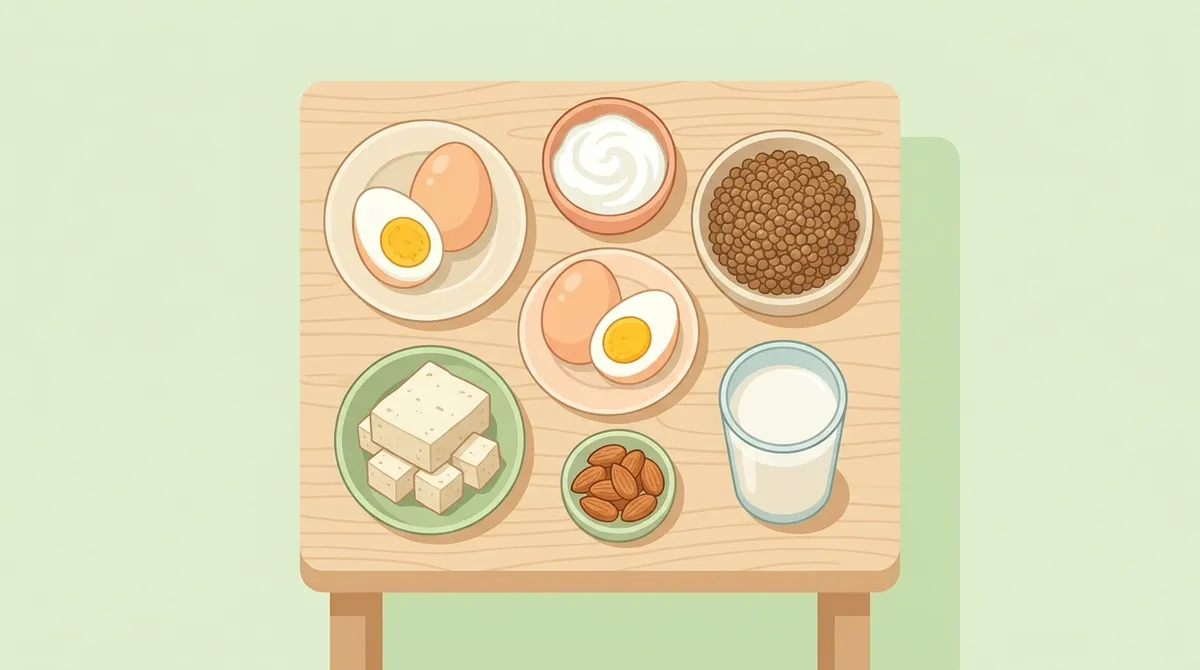
Notice the last row too: bread, pasta and grains aren't protein foods, but they do contain some, and it adds up over the day.
A sample day with about 85 g of protein
Here's what a day could look like for someone who weighs 155 lb (70 kg) and aims for 1.2 g per kg. Portions are a guide: your total calories depend on your own needs, which you can estimate with the guide on how many calories you should eat to lose weight.
| Meal | What to eat | Protein (approx.) |
|---|---|---|
| Breakfast | Greek yogurt (150 g) with berries and 1 oz of almonds | 20 g |
| Lunch | Whole-wheat pasta (80 g dry) with lentils (150 g cooked), cherry tomatoes and zucchini | 26 g |
| Snack | A hard-boiled egg and an apple | 6 g |
| Dinner | Pan-fried tofu (150 g) with broccoli, peppers and a little brown rice | 26 g |
| Evening | A glass of milk | 7 g |
| Total | about 85 g |
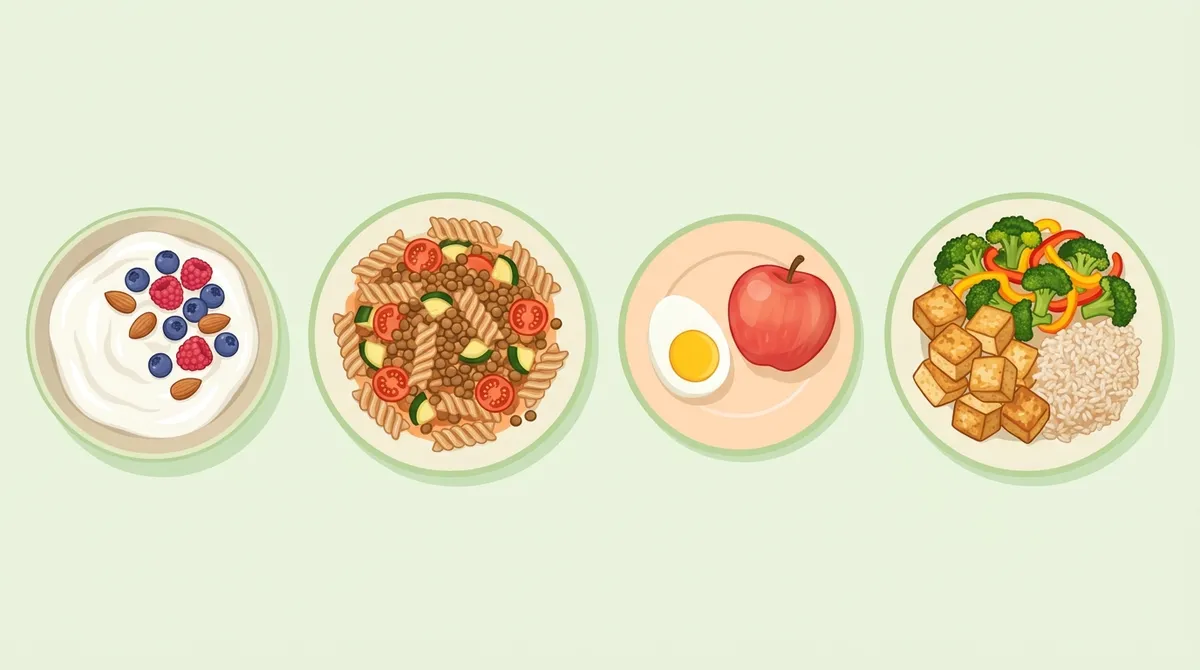
Every meal has a protein source, but also vegetables and carbs. You can swap the tofu for eggs, fish or cottage cheese: for more ideas, see the guide on healthy dinners for weight loss.
Is plant protein enough?
Yes, as long as you mix it up. Harvard recommends getting protein from plants when possible and choosing beans, nuts, fish or poultry over red meat, while avoiding processed meats like bacon, hot dogs and cold cuts2.
Beans and lentils also fill you up and are cheap: a few cans of chickpeas, black beans or lentils are some of the most useful things to keep in your pantry.
Is too much protein bad for you?
For healthy people, the amounts in this guide aren't a problem. An analysis of 28 studies with more than 1,300 adults without kidney disease found no harmful effect on kidney function from higher-protein diets9.
A few things to keep in mind, though:
- if you have kidney disease or another health condition, decide your protein intake with your doctor;
- more protein doesn't mean only protein: diets that cut out carbs, fruit and vegetables are hard to stick with and leave out fiber;
- you don't need supplements to reach your target: regular food is enough.
How to know if you're eating enough protein
The simplest way is to look at what you actually eat for a few days. Many people find that breakfast and snacks have almost no protein. Research also shows a consistent link between tracking your meals and losing weight10.
With eatamame, you just take a photo of your plate or describe it, even by voice: you instantly see estimated calories and macros, including protein, plus a star rating and a comment from the bean. In a few seconds you'll know whether the meal will carry you to the next one without hunger, or whether something's missing.
The most common mistakes
- Saving all your protein for dinner: breakfast and lunch end up light, and hunger shows up sooner.
- Forgetting about calories: protein has calories too. To lose weight, you still need to eat a little less than you burn.
- Trusting the word "protein" on the label: bars, cookies and protein snacks can be high in sugar. A Greek yogurt or an egg does the same job with fewer surprises.
- Cutting vegetables and carbs to make room for protein: a balanced plate is still the foundation, as the guide on how to lose weight without dieting explains.
- Eating the same foods every day: rotating beans, eggs, dairy, tofu and fish makes your day more varied and easier to keep up.
Frequently asked questions
Is 1 gram of protein per pound too much?
+
It's more than most people need to lose weight. One gram per pound is about 2.2 g per kg, above the 1.2–1.6 g per kg range used in weight-loss research. It's mainly used by people doing heavy strength training.
Does protein make you lose weight on its own?
+
No. You only lose weight when you take in less energy than you use. Protein makes the process easier because it fills you up and protects your muscle, but it doesn't cancel out extra calories.
Do I need protein powder or protein bars?
+
Usually not: yogurt, eggs, beans, tofu, dairy and nuts get you there without much effort. Many "protein" products also have sugar and calories you might not expect, so check the label.
How much protein do I need if I don't eat meat?
+
The same number of grams. You can reach it with beans, lentils, tofu, eggs, yogurt and cottage cheese, nuts and whole grains, mixing sources through the day.
Is it better to eat protein in the morning or at night?
+
There's no single best time. What matters more is spreading it across your meals: many people eat very little protein at breakfast and a lot at dinner, and the morning is the easiest place to add some.
Sources
- EFSA – EFSA sets population reference intakes for protein (2012)
- Harvard T.H. Chan School of Public Health – The Nutrition Source: Protein
- Leidy HJ et al. – The role of protein in weight loss and maintenance, American Journal of Clinical Nutrition (2015)
- Weigle DS et al. – A high-protein diet induces sustained reductions in appetite, ad libitum caloric intake, and body weight, American Journal of Clinical Nutrition (2005)
- Wycherley TP et al. – Effects of energy-restricted high-protein, low-fat compared with standard-protein, low-fat diets: a meta-analysis of randomized controlled trials, American Journal of Clinical Nutrition (2012)
- Kim JE et al. – Effects of dietary protein intake on body composition changes after weight loss in older adults: a systematic review and meta-analysis, Nutrition Reviews (2016)
- Longland TM et al. – Higher compared with lower dietary protein during an energy deficit combined with intense exercise promotes greater lean mass gain and fat mass loss, American Journal of Clinical Nutrition (2016)
- USDA – FoodData Central
- Devries MC et al. – Changes in kidney function do not differ between healthy adults consuming higher- compared with lower- or normal-protein diets: a systematic review and meta-analysis, Journal of Nutrition (2018)
- Burke LE et al. – Self-monitoring in weight loss: a systematic review, Journal of the American Dietetic Association (2011)
This guide is for information only and does not replace advice from a doctor or nutritionist. If you have a health condition, are pregnant or have specific needs, talk to a professional.