Team eatamame

To count calories from a photo, snap your plate before you start eating: the app recognizes the foods, estimates the portion and works out calories and macros. The estimate isn't perfect, especially with oil, sauces and mixed dishes, but if you add what the photo can't see and log every meal, it becomes a reliable way to understand what you eat.
How counting calories from a photo works
If you're wondering how to count calories from a photo, the idea is simple: swap a handwritten food log for a quick snap of your plate. In a few seconds, the app does what used to take a scale and nutrition tables:
- recognizes the foods on the plate (pasta, salad, chickpeas…);
- estimates the portion from the size of the food compared with the plate and nearby objects;
- calculates calories and macros (protein, carbs, fat) using a food database.
The idea didn't start with apps. Researchers have used meal photos for years to measure how much people eat: in one study, smartphone photos analyzed by trained staff estimated daily calorie intake with no significant difference from the lab's gold-standard method1.
What's new is that artificial intelligence now does the analysis in real time. That's far more convenient, but it comes with a trade-off you should know about: accuracy.
How accurate is a calorie estimate from a photo?
A photo gives you an estimate, not an exact number. Here's what the research says:
- A meta-analysis of 13 studies found that photo-based methods tend to underestimate calories, by about 180 kcal on average2.
- A study of popular apps found that automatic recognition works better on simple foods and struggles more with mixed dishes and cuisines from other countries3.
- In a 2026 test on 102 lab-weighed meals, four apps underestimated by 250 to 345 kcal per meal, mostly because they missed around 30 g of fat. These are preliminary results that haven't been published in a journal yet4.
In general, the more convenient a method is, the less precise it tends to be, and no method is perfect in every situation5.
That said, the fair comparison isn't with a lab scale, it's with memory. In a study of people who struggled to lose weight, the amount they thought they ate was only about half of what they actually ate6. Even an imperfect photo is far more reliable than "I'm pretty sure I didn't eat much".
| Method | Accuracy | Time needed | Easy to keep up? |
|---|---|---|---|
| Weighing every food | High | A lot | Hard |
| Food diary from memory | Low | Medium | Medium |
| Photo with no corrections | Medium | Very little | Easy |
| Photo + checking portion and add-ons | Good | Little | Easy |
The last row is the sweet spot: the speed of a photo plus 10 seconds of checking. That's what the 6 steps below are for.
How to count calories from a photo in 6 steps
1Snap it before the first bite
Take the photo as soon as the plate hits the table, before you start. If you snap it halfway through, the app can't see the full portion. If you leave a lot on the plate, you can adjust afterwards or take a second photo.
2Get the whole plate in the shot, from above
The best photo is from above or at a slight angle, with the whole plate in the frame and good light, without harsh shadows. If you can, keep foods a little apart: a plate where every component is visible is much easier to recognize.
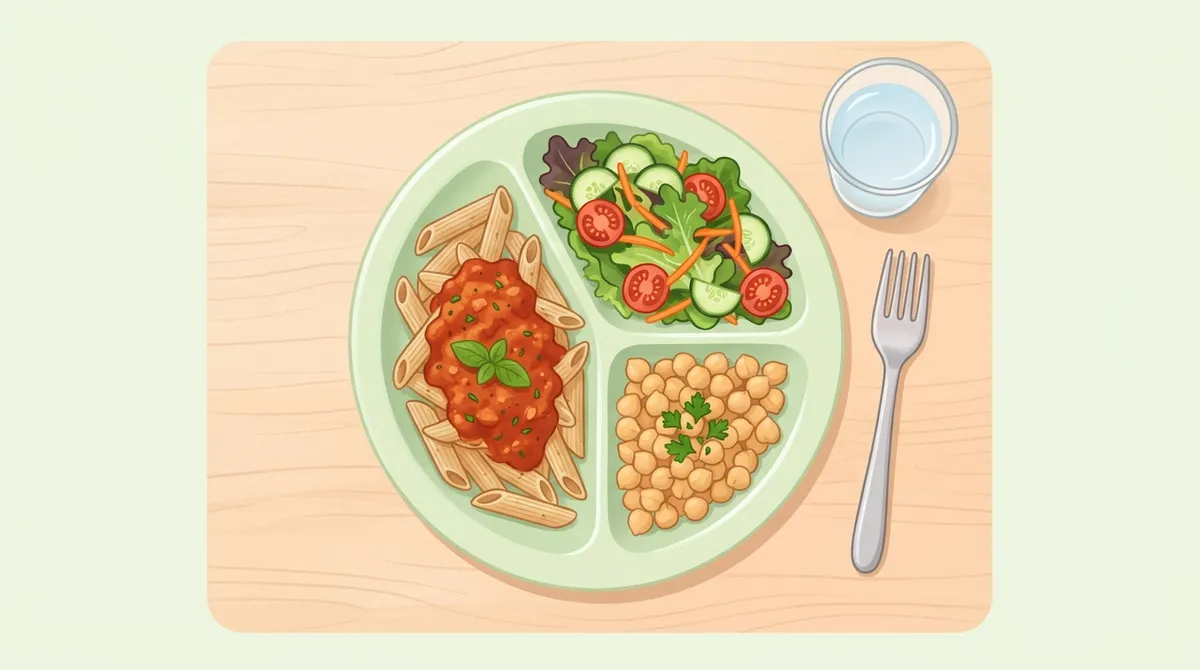
3Leave a size reference next to the plate
The app estimates quantity by comparing the food with what's around it. A fork, a glass or the rim of the plate help it tell a small portion from a generous one. Watch out for deep plates and bowls: a photo from above can't see how deep they are, so double-check the estimated portion.
4Add what the photo can't see
This is the step that makes the biggest difference. Oil, butter, cream, sugar in your coffee and sauces are often invisible, yet fat is exactly what estimates miss the most4. And fat adds up: 1 gram of fat provides 9 kcal, more than twice as much as carbs or protein7.
A single tablespoon of oil (about 14 g, or half an ounce) is roughly 120 kcal: in a bowl of pasta or a dressed salad, it's easy to reach two or three tablespoons without noticing.
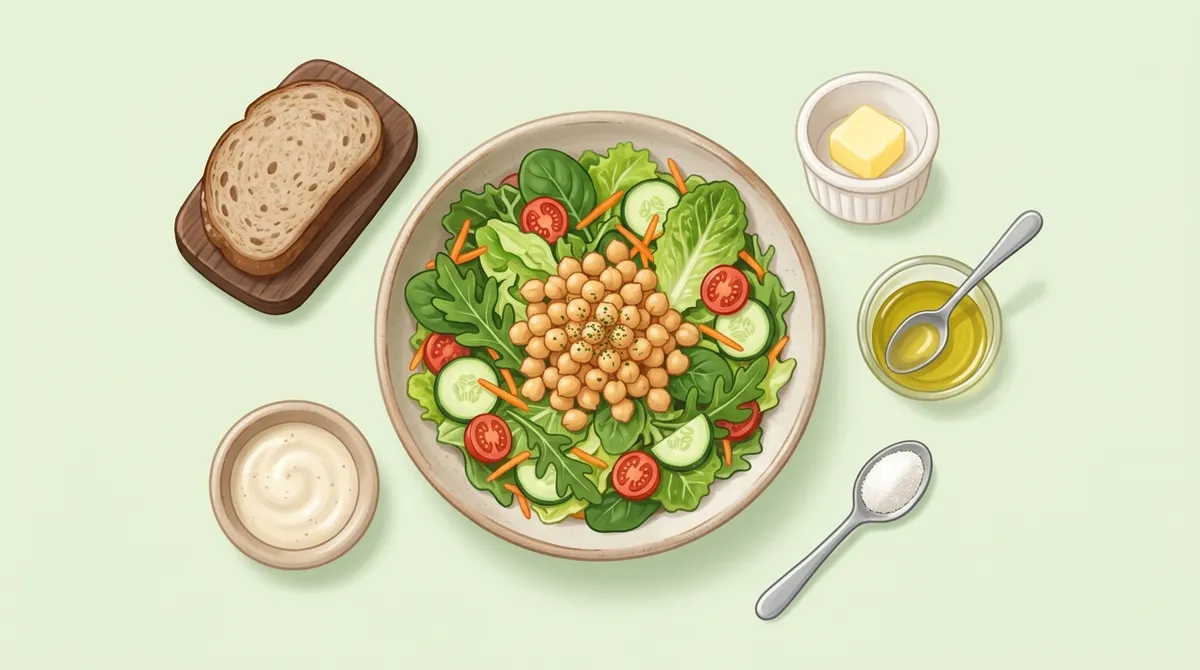
Try this: after taking the photo, add a quick note about the extras, like "with 2 tbsp olive oil" or "with mayo". It takes 5 seconds and brings the estimate much closer to reality.
5Check the estimate and fix it
Before saving, glance at the result: are the foods right? Does the portion look realistic? If the app mistook rice for couscous or only saw half the portion, correct it. For mixed dishes (lasagna, soups, casseroles), describing the main ingredients in words helps.
For packaged foods, the label is still the most precise source: if you eat a whole yogurt or bar, use the values on the pack.
6Photograph snacks and drinks too
The calories that slip through most often are the ones between meals: the sweetened latte, the soda, the after-work drink, the cookie on the go. No need to plate anything: a quick photo is enough not to forget them.
With eatamame you snap a photo or describe your meal, even by voice, and get estimated calories and macros in seconds, with the option to adjust portions and ingredients.
When a photo works well (and when it needs help)
| Type of meal | How accurate the photo is | What to do |
|---|---|---|
| Fruit, yogurt, bread, eggs | Good | The photo is enough |
| Plate with separate foods | Good | Check the portion |
| Pasta, risotto, soups | Medium | Add the dressing and the size of the bowl |
| Dressed salads, fried food, baked dishes | Lower | Add oil, sauces and cheese in words |
| Drinks | Low | Write what and how much (e.g. "can of cola") |
| Packaged foods | Varies | Use the values on the label |
Why consistency matters more than precision
Your photos don't need to be perfect. Research consistently links keeping track of what you eat with weight loss8. And frequency matters most: in a 6-month study, people who lost at least 5% of their weight opened their food log more often during the day, while the time they spent on it each day went down over the weeks9.
That's where photos help: they take seconds, so they're easier to do at every meal. A slightly imprecise but consistent estimate still shows you the habits that matter: portions creeping up, evening snacks, the days you eat more.
If your goal is to lose weight, you can combine photos with the habits in our guide on how to lose weight without dieting.
The most common mistakes
- Snapping after you've started eating: the estimated portion will be smaller than the real one.
- Forgetting the extras: oil, butter and sauces are the biggest source of error. Measuring oil with a spoon instead of pouring freely makes your notes much easier.
- Ignoring the label: for packaged foods, the NHS suggests checking the "energy" heading on nutrition labels for calorie information10. It beats any photo estimate.
- Trusting the number blindly: read an estimate as a ballpark, not down to the gram.
- Only photographing the "good" meals: if you skip the days you eat more, your weekly picture isn't real.
- Obsessing over every calorie: the goal is to understand your habits, not to control everything. If counting makes you anxious, talk to a professional.
Frequently asked questions
Are calorie-counting photo apps accurate?
+
They give you a useful estimate, not an exact number. Studies show they tend to underestimate, especially fat and mixed dishes. They get much more reliable when you check the portion and add oils, dressings and sauces.
Can I count calories in a home-cooked meal from a photo?
+
Yes, but the photo can't see what went into the pan: oil, butter or cream. Snap the dish and add the hidden ingredients in words, for example "pasta with 2 tablespoons of olive oil".
Is it better to photograph meals or weigh food?
+
Weighing is more precise, but it takes longer and is harder to keep up every day. For most people, a photo of every meal is more sustainable and, done consistently, it's enough to see your habits.
Can ChatGPT count calories from a photo?
+
A general AI assistant can give you an estimate, but it has the same limits as photo apps: portions and hidden fats. A dedicated app also saves your meals over time, so you see the trend across the week, not just one plate.
Should I photograph snacks and drinks too?
+
Yes, especially sugary drinks, alcohol and bites between meals: those are the calories people forget most easily. A quick photo is enough, no need to plate anything.
Sources
- Martin CK et al. – Validity of the Remote Food Photography Method (RFPM) for estimating energy and nutrient intake in near real-time, Obesity (2012)
- Ho DKN et al. – Validity of image-based dietary assessment methods: a systematic review and meta-analysis, Clinical Nutrition (2020)
- Li X et al. – Evaluating the quality and comparative validity of manual food logging and AI-enabled food image recognition in apps for nutrition care, Nutrients (2024)
- American Society for Nutrition – Photo-based calorie tracking apps may underestimate energy in meals, NUTRITION 2026 (preliminary results)
- Höchsmann C, Martin CK – Review of the validity and feasibility of image-assisted methods for dietary assessment, International Journal of Obesity (2020)
- Lichtman SW et al. – Discrepancy between self-reported and actual caloric intake and exercise in obese subjects, New England Journal of Medicine (1992)
- NHS – Facts about fat
- Burke LE et al. – Self-monitoring in weight loss: a systematic review, Journal of the American Dietetic Association (2011)
- Harvey J et al. – Log often, lose more: electronic dietary self-monitoring for weight loss, Obesity (2019)
- NHS – Understanding calories
This guide is for information only and does not replace advice from a doctor or nutritionist. If you have a health condition, are pregnant or have specific needs, talk to a professional.